- Python
- System design
You Can't Undo a Command Sent to Mars
Practical idempotency: how to safely command a Mars rover and keep it out of a crater
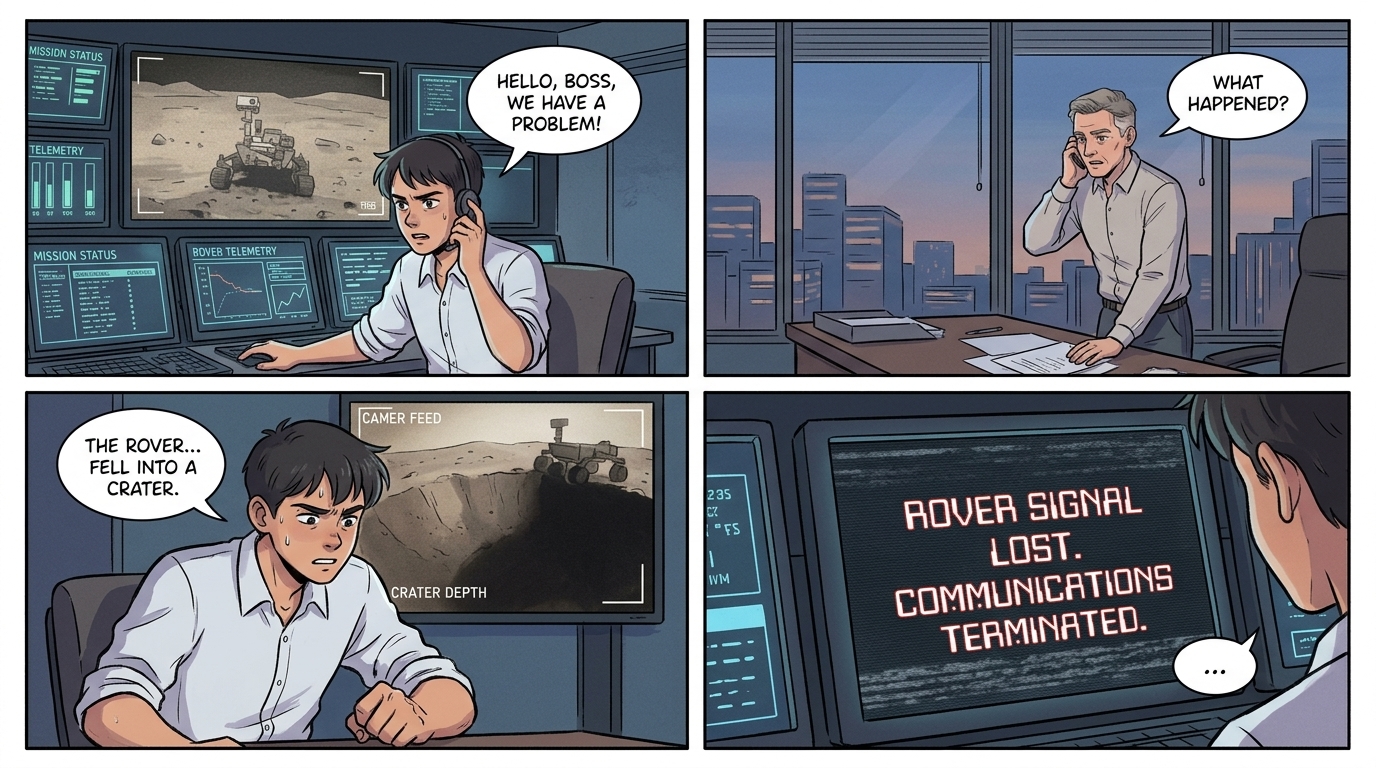
And it could have been avoided. When an operator on Earth sends a command to the rover, the signal travels one way for anywhere between 3 and 22 minutes (depending on how the planets are aligned) — so a full round trip can take almost three quarters of an hour.
Let’s say we send the command drive_forward(10m) and get no confirmation. The operator sends the message
again — and everything ends just like in our comic.
Idempotency starts in your API’s shape, not in your code
Sometimes the simplest solution is to design the API correctly in the first place. Some operations are idempotent by definition, others never are.
| Command | Semantics | Called twice | Final state |
|---|---|---|---|
drive_to(10) | absolute | (→10), (→10) | x = 10 |
drive_forward(10) | relative | (+10), (+10) | x = 20 |
set_heading(90) | absolute | (→90°), (→90°) | heading = 90° |
rotate_by(90) | relative | (+90°), (+90°) | heading = 180° |
A relative operation describes a change; an absolute one describes the expected end state. That distinction matters, because it defines what we actually expect our code to guarantee.
Radio silence — or how to talk to each other
The idempotency key belongs to the request, not the attempt
The most important thing to remember: the sequence number (the idempotency key) must be assigned when the command is created, never when it’s sent.
@dataclass(frozen=True)
class Command:
    seq: int
    name: str
    kind: Kind
    args: dict
This is one of the most common mistakes: on a retry a fresh number gets assigned, and a new number means a brand-new command as far as the rover is concerned.
The Martian way of handling it
On Earth everything is much easier: we drop the command into a database, set
ON CONFLICT DO NOTHING, and call it a day.
On Mars the real fun begins. The rover has limited resources, and its processor is built to survive the harshest conditions at the cost of raw compute. So we’ll be working within a tight budget.
WINDOW_SIZE = 64

@dataclass
class Rover:
    x: float = 0.0
    y: float = 0.0
    heading: float = 0.0

    #: The lowest number we haven't executed yet.
    expected_seq: int = 0
    #: Commands from the future, waiting for the gap to be filled.
    pending: dict[int, Command] = field(default_factory=dict)

    def _execute(self, cmd: Command) -> None: ...  # among other things, self.expected_seq += 1

    def _run(self, cmd: Command) -> Ack:
        self._execute(cmd)
        return Ack(cmd.seq, executed=True, detail="executed")

    def receive(self, cmd: Command) -> list[Ack]:
        if cmd.seq < self.expected_seq:
            return [Ack(cmd.seq, executed=False, detail="duplicate")]

        if cmd.seq >= self.expected_seq + WINDOW_SIZE:
            return [Ack(cmd.seq, executed=False, detail="out_of_window")]

        if cmd.seq in self.pending:
            return [Ack(cmd.seq, executed=False, detail="duplicate_buffered")]

        if cmd.seq > self.expected_seq:
            self.pending[cmd.seq] = cmd
            return [Ack(cmd.seq, executed=False, detail="buffered")]

        # Run the current command and everything it unblocks.
        acks = [self._run(cmd)]
        while (nxt := self.pending.pop(self.expected_seq, None)) is not None:
            acks.append(self._run(nxt))
        return acks
A duplicate still needs an ack
Whether or not the operation has already run, we have to respond to it. Most likely mission control resent the command because it never got an answer. Leave them without a reply and they’ll keep retrying forever.
if cmd.seq < self.expected_seq:
    return [Ack(cmd.seq, executed=False, detail="duplicate")]
Outside the window, we don’t guess
We get a message with a number 1000 higher than the last one we executed — what could that mean? Either some stray packet from years ago just reached us, or we’ve lost over 1000 commands. Either way we have to respond with a request to resync: for example, we could send our own number and let mission control replay every command that follows it.
if cmd.seq >= self.expected_seq + WINDOW_SIZE:
    return [Ack(cmd.seq, executed=False, detail="out_of_window")]
Deduplication isn’t the same as ordering
Our commands can arrive out of order, and running rotate_by then drive_forward leaves the rover in a
completely different place than drive_forward then rotate_by.
Idempotency won’t solve ordering for us, so if order is critical to the system, we need to remember to buffer.
if cmd.seq > self.expected_seq:
    self.pending[cmd.seq] = cmd
    return [Ack(cmd.seq, executed=False, detail="buffered")]
buffered confirms receipt, not execution. A buffered command only runs once the gap in front of it is
filled — and its sender needs to find out when that happens. That’s why receive doesn’t return a single
Ack but a list: one for the current command and one for each command it unblocks. Every Ack carries its
own seq, so mission control can match each confirmation to the right request.
seq=5 (gap at 4) -> [Ack(5, executed=False, "buffered")]
seq=4            -> [Ack(4, executed=True, "executed"),   # current
                    Ack(5, executed=True, "executed")]   # unblocked from the buffer
Without this, the sender of seq=5 would be stuck holding a lone buffered and would retry it forever —
exactly the problem we set out to solve in “A duplicate still needs an ack.”
This is only a simulation
There’s no real radio here, no memory limits, and we’ve deliberately skipped topics like command priorities and concurrency. Still, here’s what’s worth taking away:
- The idempotency key belongs to the request, not the attempt. Assigned once, at creation. A retry doesn’t change it.
- A duplicate must get a definitive answer. Silence or an error just makes the sender keep retrying.
- Deduplication and ordering are two different problems. Solving the first doesn’t give you the second for free.
- When you’re not sure whether it’s a duplicate — reject, don’t guess. A false rejection costs one retry. A false acceptance costs you the rover.
- And above all: design absolute operations, not relative ones.
set_state(x)instead ofchange_state_by(delta).